

Between Worlds: The Mirage Realm and its Intersection Points
This post is part of my ongoing world-building series exploring the geography, magic, culture, and history of Dimidium. The complete series (3 parts) lives on my website, but you can start reading here to see if it catches your interest.
Read PART 1 on the Website | Read PART 2 | Read PART 3||
Explore Dimidium’s Lore Archive
Part 1: First Crossing
Learning to See Between Worlds
The air shimmers at the edge of the dune, and Sareth knows it isn’t heat distortion.
The sun set an hour ago. The desert cold has already settled into her bones, turning her breath to mist and her fingers numb beneath the layered wraps. Heat mirages don’t happen in the cold. Heat mirages don’t look crystalline, faceted, like someone took reality itself and cut it like glass.
This is real. This is actually happening.
Beside her, Hakeem watches the shimmer with the patience of someone who’s done this a hundred times before. His weathered hands rest on the crystalline marker embedded in the rock at their feet—a trace mark that exists simultaneously in physical reality and somewhere else. Somewhere Sareth is about to visit for the first time.
“Not yet,” Hakeem says quietly. “Keth hasn’t risen. The window isn’t stable.”
Sareth resists the urge to step forward. The shimmer calls to her. Not with sound—with something deeper. A pull she feels behind her eyes, in her chest, like homesickness for a place she’s never been.
She can almost see movement within the distortion. Faceted patterns that suggest meaning she doesn’t quite understand yet. Beauty compelling her forward despite every instinct that says wait, prepare, understand before you leap.
But she waits.
Because the first lesson of the Flowing Trace Tribe is patience. The second is preparation. And the third—the most important—is that crossing between worlds without both will kill you faster than the desert heat ever could.
Understanding the Mirage
The Mirage Realm isn’t a metaphorical space, nor a legend.
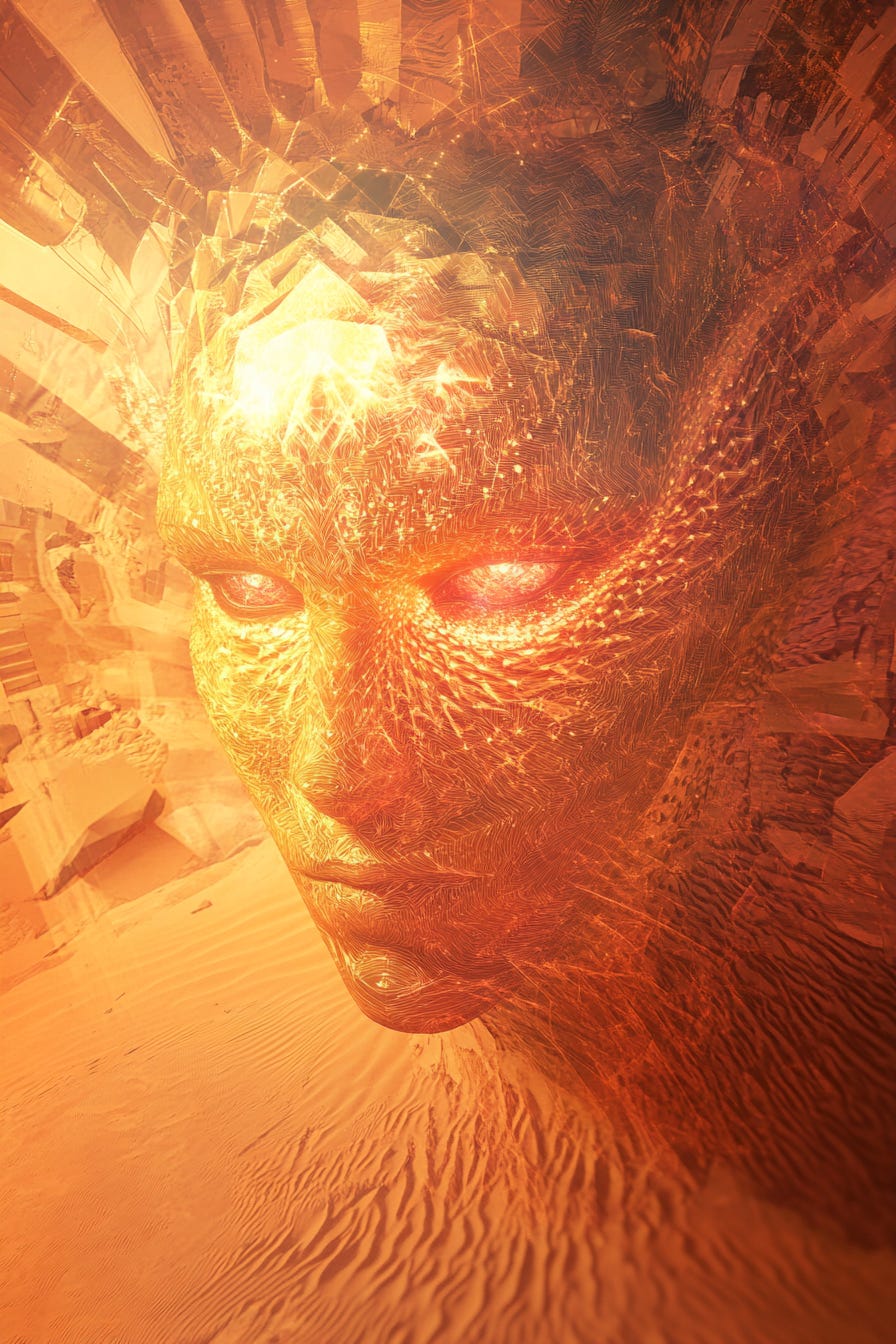
It’s not hallucination or vision or atmospheric trick. It’s a genuine parallel dimension occupying the same physical space as material reality but existing—for lack of better human terminology—at a different frequency.
Think of it this way: if physical reality is a sheet of fabric stretched taut, the Mirage Realm is another sheet laid directly beneath it. So close the two almost touch. Maintained at constant separation by forces we don’t fully understand. Most of the time, you perceive only the top sheet. The physical world, solid and predictable, the one where gravity works and time flows forward and matter stays where you put it.
But at certain locations, under specific conditions, the sheets press close enough together that you can see through.
Or reach through.
Or, if you’re very unlucky or very prepared, pass through entirely.
The desert tribes discovered this centuries ago—probably during the great binding ritual that contained the entity beneath the crimson sands. Maybe even before, as whatever consciousness exists in that bound state apparently exists simultaneously in both realms. Its influence explains why the boundary between worlds remains particularly thin throughout the Crimson Desert. Why intersection points cluster here more than anywhere else in Dimidium. Why Sareth’s people have spent several centuries learning to navigate something most people never even perceive.
In the Mirage Realm, consciousness flows like water. Thought takes solid form. Distance operates according to conceptual proximity rather than physical measurement. Two locations might be “close” because they share similar emotional resonance, even if they’re separated by hundreds of miles in physical space.
Time doesn’t flow linearly there. Cause and effect follow rules that make human logic seem quaint.
It’s beautiful beyond measure.
And it’s dangerous precisely because that beauty compels you to stay.
Three Days of Preparation
Sareth hasn’t eaten solid food in three days.
The fasting is intentional—designed to reduce what Hakeem calls “physical anchoring.” The heavier your connection to material reality, the harder it is for consciousness to shift frequencies. So you lighten yourself. Reduce the body’s demands. Make yourself less solid, less bound to the physical world, more able to perceive what exists at slightly different wavelengths of existence.
Her stomach has stopped complaining. Now there’s just a floating sensation, a lightness that makes the cold seem distant and her thoughts sharp and strange. Three days and the hunger doesn’t even bother me anymore. That can’t be normal.
The meditation helps too. Hours each day practicing what Hakeem describes as “mental flexibility”—learning to hold contradictory perceptions simultaneously without judgement, without your mind fragmenting. Learning to process doubled awareness. Learning that “here” and “there” can be the same location experienced at the same time.
Most people’s brains reject this kind of thinking. They can’t hold the contradiction. They perceive one reality or the other, never both simultaneously.
Resonants—the Flowing Trace term for people capable of crossing—can. Their minds structured for the kind of doubling that makes intersection point navigation possible.
It’s not common, but not excessively rare either. Maybe one in four tribe members shows the capacity. Sareth saw her first shimmer at twelve, and she’s spent the eight years since training for this moment.
For her first deliberate crossing between worlds.
The blood sigil is already prepared. Hakeem cut his palm with the ceremonial blade an hour ago, tracing the geometric pattern on the anchor stone—the framework that will serve as Sareth’s tether to physical reality. Then he passed the blade to her.
Her hands only shook slightly as she added her blood to the pattern.
The moment her blood touched his, something shifted. Not physical. Not quite magical. But real nonetheless. Undeniable. She felt the connection establish between them—a link that transcends normal human communication. If she gets lost between worlds, Hakeem will be able to find her through this blood bond. He’ll be able to pull her back.
That’s the theory, anyway.
Sareth touches the cut on her palm now, feeling the sting beneath the wrapping. The pain grounds her. Reminds her that she still has a body. That physical reality exists and she belongs to it, even if she’s about to visit somewhere else.
“The window opens in seventeen minutes,” Hakeem says quietly. He’s checking the sky—tracking Keth’s position, calculating the alignment of the twin moons. “We have approximately thirty minutes of stable crossing conditions before the alignment shifts.”
Seventeen minutes of waiting. Thirty minutes on the other side.
Sareth focuses on breathing. On staying present. On not letting anticipation pull her forward before the window actually opens.
Around them, the desert spreads in every direction—crimson sand darkening to rust in the twilight, dunes rising and falling like frozen waves, the distant shimmer of other intersection points visible as distortions against the horizon.
This is her home. The Shifting Seas region of the Crimson Desert, where massive dune formations migrate several feet each day and reality’s boundaries grow permeable with predictable irregularity. She’s navigated these sands since childhood. She knows them.
But she doesn’t know what lies beneath them. What exists in the spaces between here and there.
Not yet.
“Keth has risen,” Hakeem says. His voice carries a note of formality now—the tone he uses for ceremonial moments. “The twins are in favorable opposition. The window is opening.”
The shimmer intensifies. Sareth can see it clearly now—not like looking through water or heat distortion, but like reality itself has become translucent. Faceted. As if the world is made of glass and she’s seeing the structure underneath.
Hakeem stands. Offers his hand.
Sareth takes it.
No turning back now.
“Remember,” he says. “Feel the pull toward the pattern. Don’t accept. Maintain your anchor. We’re visitors, not residents.”
She nods. Her throat is too tight for words.
Hakeem steps forward into the shimmer.
Sareth follows.
The Crossing
The crossing feels like nothing she’s experienced before.
Like stepping from warm water into cold. Like the moment between sleeping and waking. Like breathing in when you expected to breathe out. Like every metaphor she’s ever heard for transition and none of them, because language wasn’t designed to describe what happens when consciousness shifts between frequencies of reality.
Her vision doubles.
She sees Hakeem beside her—solid, present, his weathered face illuminated by the last light of sunset. And simultaneously, she perceives him as pattern and light in the space beyond. His awareness visible as an ever-changing geometric structure, thought made manifest, intention taking form.
She sees the desert around them—crimson sand, darkening sky, the anchor stone with its blood sigil gleaming wet. And simultaneously, she experiences angular architectures that bear no resemblance to physical landscape. Structures that suggest architecture without being buildings. Patterns that imply meaning without using symbols.
It’s a lot. Almost too much. Her mind wasn’t designed to process this. She feels her thoughts fragmenting, trying to attend to both perceptions simultaneously and failing, overwhelmed by the sheer volume of information flooding through her awareness.
“Feel that?” Hakeem’s voice sounds strange. Layered. As if speaking from multiple throats simultaneously, or perhaps speaking in physical reality and also somehow resonating directly in her consciousness without using sound at all. “That pull toward the pattern? That’s the Mirage Realm inviting you deeper. Don’t accept. Maintain your anchor.”
The pull is undeniable. Beautiful. Compelling. The crystalline patterns call to her with promises she doesn’t have words for. They suggest expansion, freedom, awareness unbound from physical constraints. They offer to show her what existence means when matter and gravity and linear time stop limiting perception.
All she has to do is let go.
Let go of the cold desert air. Let go of her body’s weight. Let go of the blood sigil binding her to physical reality. Just... release. Float. Flow into the patterns that are reaching for her with something like curiosity or perhaps hunger or maybe just recognition.
Sareth focuses on the anchor.
On the blood sigil carved into stone. On the warmth of her body despite the cold. On the pain in her palm where the blade cut. On the physical reality of her lungs expanding, contracting, pulling thin air into solid flesh.
The pull lessens. Slightly. But it doesn’t disappear.
“Good,” Hakeem says. His voice still sounds layered, but she’s adapting to it. Learning to process doubled input. “Now observe.”
And Sareth sees.
Consciousness moving through the crystalline space beyond reality’s edge. Patterns that suggest intelligence without resembling anything human. Beauty that makes her want to cry and laugh simultaneously. Meaning she can almost grasp, significance that hovers just beyond comprehension.
Demons. The dai’mnae.
She’s perceiving actual dai’mnae in their natural environment. Unbound. Unconstrained. Existing as thought itself in forms that physical reality cannot contain.
They’re aware of her. She can feel it. Attention turning in her direction. Curiosity examining her presence. Not hostile. Not threatening. But profoundly Other. Awareness operating according to rules so different from human cognition that trying to communicate would be like trying to speak with the wind.
One moves closer. Pattern shifting, geometric structure rearranging itself. It doesn’t approach the way physical beings approach—crossing distance through movement. It simply becomes nearer.
It sees me. Oh gods, it actually sees me.
Sareth’s heart pounds. She can feel it—her physical heart, beating in her physical chest, anchoring her to the material world even as her consciousness extends into spaces that shouldn’t exist.
The dai’mnae reaches toward her. Not with limbs. Patterns of intention extending, seeking connection, offering—what? Communication? Partnership? Simple acknowledgment of her presence in its realm?
“Don’t,” Hakeem says sharply. “Not without proper binding. Uncontrolled contact will fragment your consciousness.”
Sareth pulls back. The dai’mnae doesn’t follow. It simply... withdraws. Pattern contracting back into itself. Attention turning elsewhere.
She realizes she’s trembling.
“Thirty minutes,” Hakeem says. His voice carries satisfaction. Pride. “Time to return.”
Already? It feels like they just arrived. Or perhaps like they’ve been here for hours. Time doesn’t flow right in this space. Duration loses meaning when cause and effect don’t follow linear progression.
They step out of the shimmer together.
Sareth’s legs give out immediately. Hakeem catches her before she falls, lowering her carefully to the sand beside the anchor stone.
“Everyone reacts this way after the first crossing,” he says. There’s warmth in his voice now. Genuine affection. “You did very well. Rest now, meditate. Let your consciousness settle.”
Sareth can’t speak. Can barely breathe. All she can think is:
I need to go back.
Making Sense of The Mirage
Now that we’ve experienced a crossing, what IS this place?
The Mirage Realm exists alongside physical reality the way harmony exists alongside melody. It’s not a different location—it’s the same space perceived at a different frequency. Most people spend their entire lives aware of only one frequency. The material world. The realm where matter obeys predictable laws and consciousness stays bound within physical constraints.
But consciousness isn’t actually limited to physical form. It can exist—does exist—at other frequencies. The Mirage Realm is where awareness flows free. Where ideas and desires become structures without requiring brains to process them. Where meaning manifests as patterns rather than linguistic symbol.
Distance there, as mentioned, doesn’t follow physical measurement. Two locations might be “close” in the Mirage Realm because they share emotional resonance, even if they’re separated by hundreds of miles in material space. A place of great joy might be conceptually adjacent to another place of joy, regardless of physical geography.
Temporal progression breaks down. Past, present, and future exist simultaneously, overlapping, interpenetrating. Cause and effect still operate, but not the way they do in physical reality. Actions can precede their consequences. Results can generate their origins. The whole concept of sequential progression breaks down.
And the dai’mnae—the consciousnesses native to that realm—they don’t experience existence the way humans do. They don’t have bodies. Don’t have singular identity in the way humans understand it. Don’t perceive duration or distance or causality through the same framework that makes human experience coherent.
But they’re intelligent. Aware. Their minds capable of intention and action and something that might be emotion, if emotion can exist without biochemistry to generate it.
Their beauty defies description.
And that beauty is precisely what makes them dangerous.
Because when you perceive that beauty, when you experience what awareness can be when freed from physical constraints, when you feel the pull of existence without boundaries... part of you wants to stay. Wants to dissolve into those crystalline patterns. Wants to stop being singular, limited, bound within flesh and time and the narrow constraints of human cognition.
The Mirage Realm doesn’t attack you. It invites you.
And invitation is so much more dangerous than assault.
That’s why all the protocols matter. Why the fasting, the meditation, the blood sigils binding you to physical reality. Why mentors like Hakeem maintain constant vigilance during crossing. Why the Flowing Trace Tribe has spent centuries developing techniques to navigate between worlds safely.
Not because the Mirage Realm is in itself hostile.
But because it’s beautiful enough to make you forget why you should leave.
Thessara and the First Crossing
The tribes didn’t always know about the Mirage Realm.
Seven hundred years ago, when magic practitioners performed the great binding ritual—seventeen circles carved across the Crimson Desert to contain the entity sleeping beneath the sands—they were attempting pure containment. Create barriers strong enough to hold a consciousness that threatened to consume everything. Anchor it. Lock it away. Prevent it from reaching through into physical reality ever again.
Mostly, they succeeded.
But they also created something unexpected.
The binding circles didn’t just contain the entity. They thinned reality’s boundaries. Created permanent intersection points where the membrane between worlds pressed close enough to become permeable. Made crossing easier for humans, where it had been sole dai’mnae prerogative before.
The first person to cross accidentally was a binding-keeper named Thessara. She was performing routine maintenance on one of the western circles when the window opened without warning.
She stepped into the shimmer thinking it was heat distortion.
And found herself somewhere else while still being exactly where she’d always been.
Thessara survived. Barely. She was trapped between worlds for days before the window closed and reality’s boundaries solidified enough to force her awareness back into singular perspective. She emerged from the experience fundamentally changed—unable to eat for weeks, perceiving both realms simultaneously for months, never quite fully present in physical reality again.
But she brought back knowledge.
She described the crystalline patterns. The consciousness moving through spaces that shouldn’t exist. The dai’mnae that approached her, curious, seeking connection with something they’d never encountered before in their dimension. The beauty that almost convinced her to dissolve into pattern and light rather than return to the limitations of flesh.
The tribes listened. Studied. Tested.
And eventually, they learned.
They learned that not everyone could perceive the Mirage Realm clearly. They learned that certain conditions created stable windows for crossing. Lunar alignments. Stellar configurations. The binding circles’ influence rippling outward, affecting intersection point stability in predictable patterns.
They learned that blood could create anchors across realms. That blood sigils drawn in specific geometric patterns established tethers strong enough to pull consciousness back from the Mirage Realm before dissolution became irreversible.
They learned the protocols through harsh trials and terrible errors.
Several people died in those early decades. Their consciousness fragmenting. Physical bodies as living shells, while their awareness scattered across realities. Or worse, their spirit merging with the dai’mnae, two consciousnesses contaminating each other, neither able to separate, neither able to function properly afterward.
The Flowing Trace Tribe emerged from those who survived long enough to learn. Who developed techniques for safe crossing. Who transformed disaster into mastery through centuries of careful observation and protocol refinement.
Thessara didn’t live to see it. She died within a year of her accidental crossing, her consciousness never fully recovering.
But every navigator who crosses safely does so because she endured what she did. Because she came back with knowledge instead of simply disappearing between worlds.
The binding ritual contained an entity. But it also revealed a realm.
And the tribes have been learning to navigate it ever since.
Life at the Edge
For Sareth’s people, intersection points aren’t unusual. They’re simply how things are.
Children grow up learning to recognize shimmer patterns the same way coastal children learn to read tide tables. You check the intersection conditions before planning travel. You avoid certain areas during three-moon convergences when boundary instability makes crossing dangerous. You respect the protocols the way you respect any environmental hazard, with full understanding that carelessness kills.
Theirs is a civilization built around unique conditions that other domains never encounter.
Morning water collection happens during stable boundary periods. Evening gatherings avoid zones where intersection points become active after sunset. Trade routes account for seasonal patterns in reality’s permeability, routing caravans around areas where the membrane between worlds grows too thin for safe passage.
Even children’s games reflect the reality of living where worlds overlap. They play “crossing and return”—testing how close they can approach active intersection points before adult intervention. They practice the breathing techniques that will later become meditation for consciousness stabilization. They learn early that some types of beauty require respect rather than pursuit.
Settlement locations are chosen carefully. The Flowing Trace builds permanent structures only in zones where boundaries remain reliably stable year-round. Temporary camps serve regions where intersection point activity varies with seasons or lunar cycles. You don’t put your home somewhere that might phase partially into the Mirage Realm during unfavorable alignments.
But life near thin boundaries isn’t purely a defensive pursuit.
The tribes gain significant benefits from their proximity to the Mirage Realm. Blood binding rituals achieve greater precision near intersection points—the thinness of boundaries making connection between consciousnesses easier to establish. Communication through sand-based networks carries further and faster. Preservation techniques that rely on boundary manipulation work only in zones where both realities press close together, and it’s not uncommon for temples. And other significant structure to be build, fully or partially, across realities.
Desert folks haven’t just learned to survive at reality’s edge, they’ve learned to thrive there. Because what looks like catastrophic instability to outsiders becomes opportunity when you understand how the system works.
The Guild sees atmospheric anomalies requiring study.
The Flowing Trace sees intersection points requiring navigation.
And that difference in perception—that fundamental divergence in how you understand what you’re looking at—determines whether you survive the encounter or become another cautionary tale about approaching the boundary between worlds without proper respect.
Sareth grew up hearing those cautionary tales, and now she truly understands why they matter.
Because she’s felt the pull. Experienced the beauty. Perceived what existence could be if she just... let go.
And she knows she’ll spend the rest of her life learning to navigate that beauty without dissolving into it.
Learning to cross between worlds and remember to come back.
After the Crossing
Sareth sits beside the anchor stone, watching the shimmer fade as the window closes. Her legs are steadier now. Her breathing has returned to normal. But something has changed.
How do I go back to normal after this?
She can still feel it—the echo of doubled awareness. The memory of consciousness flowing around her like sand in a storm.
Hakeem settles beside her. His decades of successful crossings showing in the way he watches the desert—as if seeing both what’s there and what lies beneath. As if never fully present in singular perspective again.
“You did well,” he says again. “Maintained your anchor. Observed without engaging. Returned when instructed.”
“I wanted to stay,” Sareth admits. The words come out barely above a whisper. Unable to look him in the eyes.
“Everyone does. That’s how you know the crossing was real.” Hakeem’s expression carries understanding and something darker. Warning, maybe. Or resignation. “The question will never be whether you want to stay. But can you navigate that want without letting it consume you.”
He stands, offering his hand again. This time to help her to her feet rather than guide her between worlds.
“Seven centuries,” he says. “And we’re still learning. Still finding new patterns. Still losing navigators who stayed too long or crossed without proper preparation or simply encountered something we didn’t yet know was possible.”
They begin the walk back to camp. The desert spreads around them—beautiful in its own right, but somehow diminished now. Less complex. Less alive. Physical reality seems thin compared to what Sareth perceived beyond it.
She begins to understand now what it means that Hakeem perceives both realms constantly. Why elder navigators gradually lose the ability to properly interact with reality.
Because once you’ve seen what lies between worlds, you can’t unsee it.
Once you’ve felt consciousness flowing free, bounded existence can feel like imprisonment.
Once you’ve experienced beauty without constraints, physical reality’s limitations become painfully obvious.
“I’ll will teach you mapping next,” Hakeem says. “How to read intersection conditions. How to predict window stability. How to navigate trough worlds with purpose instead of simply crossing and returning. All the protocols that make partnership with dai’mnae possible instead of catastrophic.”
He pauses. Looks at her directly.
“But first, you rest. Process what you experienced. Because the Mirage Realm is generous with wonder and unforgiving with carelessness. And the line between the two is thinner than the boundary between worlds.”
Sareth nods. She’s too overwhelmed for questions. Too transformed for analysis.
All she knows is this: she crossed. She perceived. She returned.
And she’ll spend the rest of her life learning to do it again.
Learning to navigate beauty that calls to her like homesickness.
Learning to be a traveler between worlds instead of a scientist studying anomalies.
Learning, as the Flowing Trace have learned across seven centuries, that some boundaries are meant to be crossed—if you approach them with the proper respect, preparation, and understanding that transformation, once begun, is irreversible.
The shimmer has faded completely now. The window that opened for her is closed. Physical reality is solid around her again.
But Sareth can still feel it beneath the surface. The other frequency. The realm that exists alongside this one, close enough to touch if conditions align.
Close enough to call to her.
Always calling.
Always.
-
To be Continued…
Continue Reading:
How do the Flowing Trace actually navigate the Mirage Realm? What protocols make dai’mnae partnership possible? And what does the Guild get catastrophically wrong?
Continue to Part 2: “Mastery and Partnership”
Want to Dive Even Deeper?
Join The Captain’s Log newsletter for previews, behind the scenes, and exclusive Dimidium content.
You can also leave a tip on Ko-fi if you’d like to directly support my work.
(The Ko-fi Store will open soon with exclusive content for all Dimidium fans.)

This is Part 1 of a 3-part series exploring the Mirage Realm, dai’mnae partnerships, and the desert tribes who maintain boundaries between realities.
The complete series can be found on my website, in the ‘Legends and Lore’ section.
New to Dimidium? Explore the world through my regional guides:
[The Dragon’s Spine] - Mountain clans, dragons, and weather-working magic
[The Living Coast] - Port cities, crystal matrices, and siren politics
[The Crimson Desert] - Binding circles and geometric magic
© 2025 E.M.V writing as Morgan A. Drake. All rights reserved.